Your Cart is Empty
Water softeners for tankless water heaters: metered Clack and Fleck softeners that keep scale out of the heat exchanger, salt-free conditioners for homes that can't run a brine drain, and softener-plus-carbon pairs for city water. Tankless heaters pass water through a narrow heat exchanger at high temperature, which is exactly where hard water scales fastest; most manufacturers call for softened water above 7 grains and some void the warranty without it. Shipped free, assembled and programmed, 5-year valve and 10-year tank warranty. Do you actually need one, which type, and what your heater's manual says: below the products.
If your hardness is above about 7 grains per gallon (120 mg/L), yes, and the heater's own installation manual will say so. A tank heater tolerates scale because it has a large volume of slow-moving water and a sacrificial anode; a tankless unit heats water on demand in a copper or stainless heat exchanger with passages a few millimetres across, running at 120–140°F. Calcium and magnesium precipitate fastest at exactly those conditions. The results are a heater that cycles, drops its flow rate, throws an error code, needs descaling every 6–12 months, and fails years early. Rinnai, Navien, Rheem, Noritz, Takagi and Bosch all publish hardness limits in their manuals and most tie warranty coverage to them.
| Your hardness | What happens in a tankless heater | What to do |
|---|---|---|
| Under 5 gpg (soft to slightly hard) | Minimal scale; annual vinegar flush is enough. | No softener needed for the heater; sediment filter recommended. |
| 5–10 gpg (moderately hard) | Scale forms within a year; flow and efficiency drop; descaling every 6–12 months. | Softener or salt-free conditioner, depending on water source. Most manufacturers' warranty threshold sits in this range. |
| 10–20 gpg (hard to very hard) | Heat exchanger scales in months; error codes; premature failure common. | Metered softener; salt-free units aren't rated for this. |
| Over 20 gpg | Severe scaling; heater life measured in a few years without treatment. | Softener sized one step up; consider twin-tank for continuous soft water. |
Don't know your hardness? City water utilities publish it in the annual water quality report; well owners need a test. Send us the number and the heater model and we'll match the system.
A salt-based softener removes the calcium and magnesium by ion exchange, so scale physically can't form. It's the only option manufacturers accept as "softened water" and the only one that handles well water or hardness above about 10 gpg. It needs a drain for regeneration and salt in the brine tank. A salt-free conditioner (TAC or citric) changes the minerals so they stay suspended instead of sticking; hardness stays in the water, but scale largely doesn't form on heated surfaces. It needs no drain, no salt, no power, and suits city water under about 10 gpg in a home where a softener can't go. On a well with iron, salt-free isn't an option; see salt-free systems for the full picture.
| Situation | Clack | Fleck |
|---|---|---|
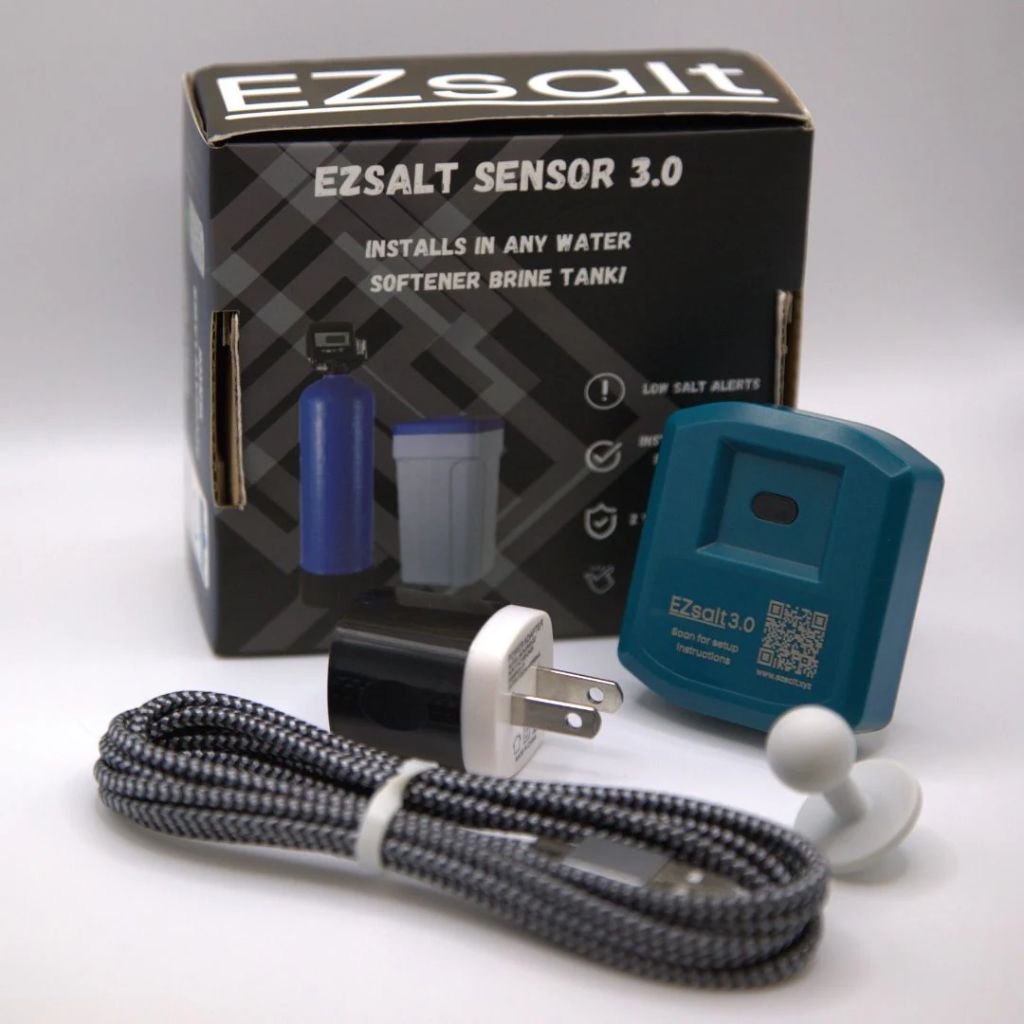
| City water, 1–4 baths, hardness 5–25 gpg | Clack WS1 with EZsalt (from $1,319) | Fleck 5600 SXT (from $879) |
| Larger home, 1″ plumbing, high-flow tankless (9+ GPM) | Clack WS 1.25 EE (from $1,999) | Fleck 5800 SXT (from $1,055) |
| Chlorinated city water: protect the heater and strip chlorine | Clack WS1 Softener + Carbon (from $2,199) | Fleck Softener + Carbon (from $2,299) |
| No drain or salt possible; city water under 10 gpg | Filtersorb salt-free conditioner (from $899) · NuvoH2O Home (from $621) · NuvoH2O Manor (from $1,011) | |
Size the softener the normal way (hardness × people × 75 gallons a day, regenerate about weekly) with one extra check: peak flow. A tankless heater draws 5–9 GPM when two showers run, and a softener undersized on flow lets hardness leak through at exactly the moment the heater is working hardest. For a 1–3 bath home on a WS1 or 5600 SXT valve (up to 20–27 GPM) this is a non-issue; for a 5+ bath home or a 1.25″ main, step up to the WS 1.25 or 5800. Install the softener on the cold main before the heater, with a sediment pre-filter if you're on a well.
Does a tankless water heater need a water softener? Above about 7 gpg, yes, both for performance and usually for warranty. Below 5 gpg, an annual descale is enough.
Will a water softener void my tankless warranty? The opposite: softened water is what the manuals specify. Check your model's manual for its stated hardness limit and keep the softener's setting below it.
Can I use a salt-free softener with a Rinnai or Navien? Manufacturers specify hardness levels, not treatment type, and a conditioner doesn't lower measured hardness. On city water under 10 gpg a TAC conditioner prevents most scale in practice; if the warranty language matters to you, a salt-based softener is the safe answer.
Does soft water corrode the heat exchanger? Properly softened water (not over-softened to zero on a high-sodium supply) is what every tankless manufacturer designs for. Keep pH neutral; on acidic well water add an acid neutralizer ahead of the softener.
Do I still need to descale? Far less often. Most owners with a softener go to a flush every 2–3 years rather than every 6–12 months.
Questions on your heater model or hardness: call 800-374-2143. Related: all water softeners · softeners for city water · softeners for well water · salt-free systems.